多选题 Choose three. You issued this command:
RMAN> BACKUP RECOVERY AREA FORCE;
Which three are true?


 2022-07-19
 共278道
共278道
相关试题
单选题 Examine this configuration: 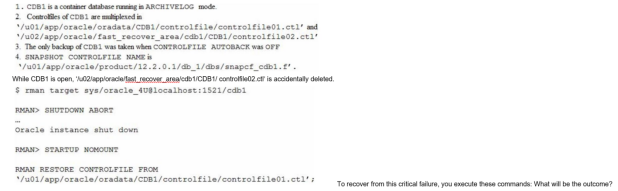
单选题 Choose the best answer. Examine this configuration:
-1. CDB1 is a container database.
-2. 2. APP_ROOT is an application root in CDB1.
-3. 3. APP_PDB1 is an application PDB in APP_ROOT.
-4. 4. FLASHBACK DATABASE is ON.
You execute these commands:
$$ sqlplus sys/orac1e_4U@localhost:1521/cdb1
SQL> SELECT current_scn FROM v$$database;
CURRENT_SCN
2074756
SQL> CREATE TABLE cdb1_tab(c1 NUMBER) ;
Table created.
SQL> ALTER SESSION SET CONTAINER=app_root;
Session altered.
SQL> CREATE TABLE app_root_tab (c1 NUMBER) ;
Table created.
SQL> ALTER SESSION SET CONTAINER=app_pdb1;
Session altered.
SQL> CREATE TABLE app_pdb1_tab (c1 NUMBER) ;
Table created.
SQL> conn / as sysdba
Connected.
SQL> ALTER PLUGGABLE DATABASE app_root CLOSE;
Pluggable database altered.
SQL> FLASHBACK PLUGGABLE DATABASE app_root TO SCN 2074756;
Flashback complete.
Which table or set of tables will exist after the Flashback operation has completed?
单选题 Choose the best answer.
Examine this output of an export from the current release of an Oracle multitenant database: $$ sqlplus system/oracle .
SQL> col name for a10
SQL> select name, open_mode from v$$pdbs;
NAME OPEN_MODE
PDB$$SEED READ ONLY
PDB1 READ WRITE
PDB2 MOUNTED
SQL> exit
Next you execute: $$ expdp system/oracle full=y
What is the outcome?
单选题 Choose the best answer. Examine this configuration:
-1. CDB1 is a container database.
-2.COMMON_USER_PREFIX is set to an empty string.
-3. PDB1 is a pluggable database in CDB1.
-4. APP1_ROOT is an application container in CDB1.
-5. APP1_PDB1 is an application PDB in APP1_ROOT.
You execute these commands: S sqlplus sys/oracle@localhost:1521/cdb1 as sysdba
SQL> CREATE ROLE role1 CONTAINER=CURRENT;
Which is true?
单选题 Choose the best answer. How do you configure a CDB for local undo mode?
单选题 You are administering a multitenant container database (COB) that contains two pluggable databases (PDBs), pdb1 and pdb2.
You are connected to pdb2 as a common user with DBA privileges.
The statistics_level parameter is PDB modifiable.
As the user sys, execute the following command on pdb2:
SQL> ALTER SYSTEM SET STATISTICS_LEVEL=ALL SID='*' SCOPE=SPFILE;
Which statement is true
About the result of this command?
单选题 Choose the best answer.
Application PDBs, SALES_APP1 and SALES_APP2, must be created and they must access common tables of the SALES_APP application.
Examine these steps:
-1. Install the SALES_APP application, including the common tables, in the application root.
-2. Install the SALES_APP application in the application root and the common tables in both the CDB root and the application root.
-3. Create an application seed. ;
-4. Install the SALES_APP application in the application seed.
-5. Create the SALES_APP1 and SALES_APP2 application PDBs.
-6. Sync the SALES_APP1 and SALES_APP2 application PDBs with the application root.
-7. Sync the SALES_APP1 and SALES_APP2 application PDBs with the application seed.
-8. Sync the application seed with the application root.
Which are the minimum required steps in the correct sequence?
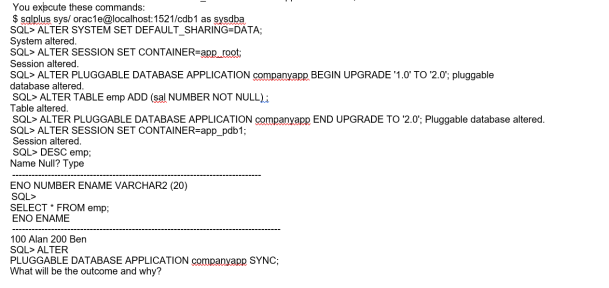
单选题 Choose the best answer. Examine this configuration:
-1. CDB1 is a container database.
-2. DEFAULT_SHARING is METADATA.
-3. APP_ROOT is an application root contained in CDB1.
-4. APP_PDB1 is an application PDB contained in APP_ROOT.
-5. COMPANYAPP is an application contained in APP_ROOT.
-6. EMP is a common table created in APP_ROOT and all its application PDBs, created when version 1.0 of COMPANYAPP was installed.